 |
| ISSUE NO. 708 |
| This week's newsletter is contributed by Sanket Jain, whose series on indigenous crops being cultivated by last-generation farmers in India is a must-read in our archives. Jain is an independent journalist and documentary photographer based in Kolhapur, India. He is a Senior People's Archive of Rural India fellow, where he's documenting vanishing livelihoods and dying art forms from India's remote villages, and is also the co-founder of Insight Walk, a nonprofit that offers teaching fellowships to rural community women. These women work to ensure every child in their village has access to contextual education of their choice - at Insight Walk, every student designs their own syllabus. Follow Jain's work on instagram @snkt_jain. . . . STARTING ON OCTOBER 3 . . .
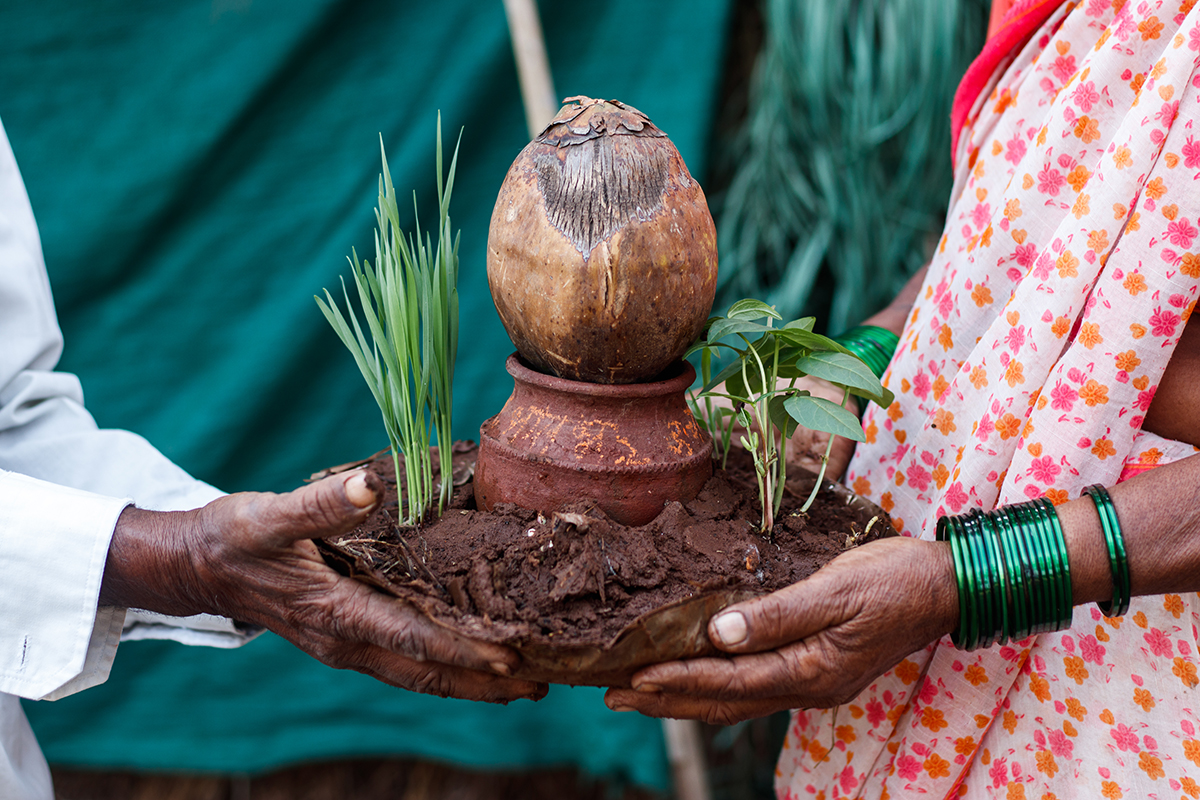
The environment-friendly plate holds a small pot with a hole, which acts as a drip water system for the seeds. The plate is kept inside the house temple, and an earthen oil lamp is lit continuously over the nine days to provide warmth.
Gaikwad, a resident of Jambhali village in Western India’s Maharashtra state, is one of several thousands of farmers who follow this cultural practice, which helps them decide what crop they will plant. “During this time, the crops that grow well are then cultivated in the next farming cycle,” she shares. This tradition is followed annually during the nine-day-long Navratri, an annual festival in honor of Goddess Durga that celebrates the victory of good over evil. This year, Navratri will be celebrated from the 3rd through the 12th of October.
After nine days, if only half the seeds of a particular crop grow, farmers sow double the seeds in the hope of a better harvest. The outcome is simple but powerful: if all the seeds sprout well, the crop will likely thrive in the field. If only half grow, farmers increase the sowing to offset potential losses.
Her family then cultivated sesame to overcome this, but it was too late as the season passed - even that ended in a loss. “There’s a reason why our ancestors believed in this practice, and looking at the losses, I too believe why it’s important,” she shares.
Almost all the crops are harvested by October or November, coinciding with the start of a new ritual of Navratri, when farmers handpick the seeds and test them as part of this tradition. “This follows the farming cycle and helps a farmer decide if the crop will grow well in the coming cycle,” explains Gaikwad’s elder son, Maruti.
This also allows them to practice multi-cropping. At a time when farmers are rapidly moving towards monocropping, this cultural practice is an important solution to several problems. However, Gaikwad says that the younger generation now buys hybrid seeds from the market that usually don’t last beyond the farming cycle, forcing them to buy them yearly. “This doesn’t serve the purpose as the idea is to test the strength of the quality of seeds that are produced on your farm and not manufactured by a giant corporation,” she shares.
Gaikwad never buys seeds and is proud of retaining several traditional varieties. Every year before Navratri, many farmers ask her for traditional seeds, which Gaikwad gives at no cost. “How can I put a price tag on seeds that help protect the environment?” she asks.
For Gaikwad, these seeds not only help farmers but also hold generations of wisdom. By sharing them freely, she wants to keep this wisdom alive, even as the world around her is changing rapidly. . . .
Yours in food, justice, and food justice, |
tidbits...resources on anti-racism, environmentalism and food culture AKA stuff we're reading / listening to / watching / noticing / thinking about / captivated by this Tuesday . . . |
 |