|
IS IT REALLY POSSIBLE . . .
to teach someone how to think?
I don't think so. I think the phrase - you may have heard it in the context of education, i.e. 'Students should be taught how to think, not what to think.' - is meant to convey something deeper and a little less likely to become a catchphrase. I think teaching someone 'how to think' actually means exposing them to a variety of different stories, experiences, perspectives, ideas, questions, and journeys.
When we encounter something that expands our minds, makes our hearts ache, provokes the fire of rage in our bellies, or leaves us with endless questions, we are learning how to think. It's not so much a question of mindfulness (though I think that can be a factor) nor of consciousness (we all have consciousness on some level.) Perhaps the effort to find the right language for it is, at least in the English language, beside the point. I'm more interested in the process. If we are learning how to think each time our thinking is challenged - by an obstacle, a new perspective or frame of reference, or by the uncanny experience of feeling that your own thoughts or heart were looked into and read directly from - then we are - all of us - learning how to think all the time.
This feels like a more accurate approach, if only because it moves us away from thinking that anything we are taught is an end result, a completion, a 'final' - or any of those other words that tend to be used in educational settings, as if, when a course of study was over, you either dropped off a cliff or soared out of sight - and toward the awareness that our learning is lifelong and ongoing.
I spend a lot of time thinking about why writing means so very much to me. What is the essence of why reading books as a child helped me to survive - in other words, saved my life? How is it possible that the same elements of story can be repeated over and over in song, fiction, memoir, or play, and audiences are still riveted rather than bored? What has the capacity to do this except our deep interconnectedness, the truths of our human and animal and elemental spirits intertwined?
As Sophie Strand writes in her essay, "Suprecellular," for Emergence Magazine, "We have behaved like ordinary cells for too long, pretending there is no movement from the inside to the outside or vice versa. We have believed, for too long, that our minds belong to us as individuals. But advances in everything from forest ecology to microbiology show us we are not siloed selves but relational networks, built metabolically by our every biome-laced breath, thinking through filamentous connectivity rather than inside one neatly bounded mind."
Something that has made me think about thinking lately is the question: what if I'm wrong? It started with an awareness, within my small family unit, that I really wanted us all to learn together - my spouse, my 14-year-old, and I - that it's okay to be wrong. About anything at all. On a daily basis. At any given time. I had an aching feeling that our everyday defenses and counter-blaming, the stuff of mundane familial interactions, were actually an opportunity to learn how to think about something in a way that I wished I had learned a long time ago. Instead of following 'expertise' as if it were a panacea for safety and success in the world, I might find my heart more open, my funny bone more tickled, and my sense of connection to other people more fluid and tender.
This question, what if I'm wrong?, left a mark on my thinking a few years ago, when I listened to Megan Phelps-Roper's Witch Trials of J.K. Rowling podcast. Having grown up within an extremist American church community, Phelps-Roper used the question to guide her in a different direction in life - one in which she was arguably learning how to think instead of following what she was told to think.
The question might feel pretty disconcerting, at first. Especially if you are someone, like myself, who struggles with standing up to authority figures, even when they are most definitely wrong. Perhaps you already spend too much time doubting or questioning yourself, your sense of reality, your beliefs. To you I say, look to this question like a prayer or a warm piece of advice. If it makes your stomach churn, you are probably feeding it with anxiety more than the wisdom that comes from deep-seated truth. Let it go and move on to another situation, where you might try applying it again with the loving tone of your most trusted friend.
This morning, I came across this beautiful exercise that might help any of us center on what matters most to us, thereby entering a place where it feels much safer to ask, what if I'm wrong? Janet Burroway, in an essay for River Teeth nonfiction journal, shares this writing exercise for her students:
"Thinking only of your first seven years, jot down whatever comes to mind in these categories: People. Places. Things. Events. Ideas. God. Now circle in each category anything that still concerns you. That...is your subject matter. What is my subject matter? What do I care about at eighty-seven? Female sexuality and male dominance. Class. Race. War. Separation of church and state. Clothes. Houses. Work in which the lines are straight and the corners are true. Acts of unexpected kindness. Ambiguity and subtext. Water. Trees."
To thinking and learning together,
Dor + Tay
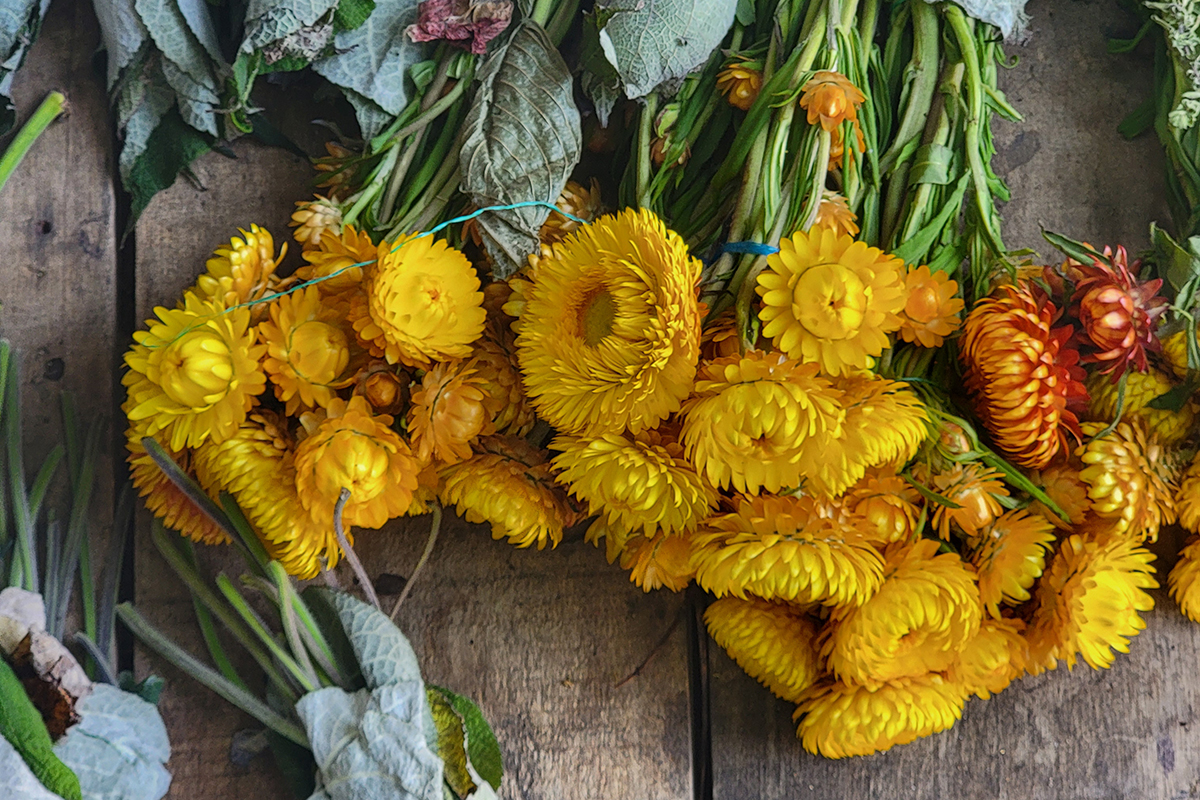
photo by Estefania Trujillo Preciado
|