issue no. 789
Today’s newsletter brings us a story about the sacred plant ken' niiohontésha and Kana'tsiohare:ke Mohawk Community's 33rd annual strawberry festival. The words were spoken by Iehnhotonkwas, Sakokweniónkwas and Paul Gorgen, and gathered by sol з, a farmer, artist & plant medicine maker. This writing is dedicated to Iehnhotonkwas – & everyone she loved, taught & changed.
STRAWBERY FESTIVALS TEND TO POP UP . . .
around the Haudenosaunee Confederacy every summer.
Hosted by schools and churches across a region known as the Mohawk Valley, locals often call these events “strawberry socials.” Though people who arrived more recently to Turtle Island may not know why they are celebrating the strawberry, the roots of these festivities originate from an ancient tradition carried by Kanien’kehá:ka (People of the Flint, or Mohawk), a nation of people who have lived on and tended to the fertile lands stretching across the middle of New York State, over mountains and across rivers, for thousands of years.
Kana’tsiohare:ke (The Clean Pot) as a community has acquired some Kanien’kehá:ka ancestral lands in the river valley. Sakokweniónkwas, also known as Tom Porter, led the movement to return to the village site of his great-grandmother’s grandmother: “My immediate family left the Mohawk Valley around 1843 when the railroad was built right through their home.” Relatives, including Standing Arrow, attempted to reclaim their lands in 1956-7, but were unsuccessful at the time. Tom Porter recalls hearing his grandmother say every year, a prophecy: one day, our grandchildren will return to the homeland. Sakokweniónkwas describes Kana’tsiohare:ke as Carlisle Indian School in reverse:
When we went in ‘93, that’s why we went – to make it a place where language could be taught or learned, and traditions, spirituality, so that people who were colonized through residential schools…Kana’tsiohare:ke was built to revitalize…whatever the residential school destroyed of our tradition, language and culture and spiritual beliefs – our community was to bring it back…to make it a living spiritual place for our people.
For Iehnhotonkwas, who also goes by Bonnie Jane Maracle, being part of Kana’tsiohare:ke was a long-awaited return to her homelands. A member of the Wolf Clan on her mother’s side, Iehnhotonkwas grew up in Tyendinaga Mohawk Territory, a community created during the 18th century by Kanien’kehá:ka families who were displaced from their lands in what is now called Fort Hunter, New York. As far back as she can trace, her family are Kanien’kehá:ka. For millennia, her ancestors lived in this river valley. Iehnhotonkwas visited Kana’tsiohare:ke throughout the year to teach in the Kanyen’kéha language program and help coordinate the annual strawberry festival.
The strawberry festival embodies Kana’tsiohare:ke’s vision for reconnecting people with ceremony, culture, land and lineage. In Kanien’kehá:ka culture, the strawberry is considered kiohekwen (our sustenance), an important medicine and a staple food.
Traditionally, a ceremony is held in June to honor the strawberry as the leader of the summer berries and fruits. This ceremony is just one of many held throughout the ceremonial year, including thanksgiving ceremonies for corn, beans, squash and maple trees. As Sakokweniónkwas says, “All the ceremonies we do throughout the year, it’s all about kiohekwen.” This illustrated Kanien’kehá:ka creation story, adapted from Mohawk storyteller Ionataié:was, explains how plants such as ken’ niiohontésha (strawberries) came to be culture bearers as well as revered medicines. In the words of Iehnhotonkwas: “This is our homelands, this is our story – but also this is too where we were told we were placed, you know, and the strawberries grew here, so the idea that we’re celebrating it here is of great significance.”
Humans from every corner of the earth have always existed in relationship with the plant medicines that grow naturally from our surroundings. As Robin Wall Kimmerer, Indigenous scientist and friend of Kana’tsiohare:ke, writes: “Plants are also integral to reweaving the connection between land and people. A place becomes a home when it sustains you, when it feeds you in body as well as your spirit.” What happens when humans become disconnected from this sense of interdependence, and we forget how to have a reciprocal relationship with the very earth that sustains us?
This mass forgetting – historical or cultural “amnesia” as anti-imperialist writer Eduardo Galeano calls it – is one of the explicit goals of colonization, which is an insidious strategy designed specifically to erase cultures and the very people who carry them.
Tom Porter teaches: “Everybody was Indigenous at one time and everybody throughout the world had spiritual ceremonies like we do, but years ago they were colonized…they severed their universal truths to our mother, the earth, and to all of the things that give us life.” This colonial and ecocidal disconnect permeates our lives today, including in how we remember history.
Sharing her perspective on what nonnative peoples consistently get wrong about Indigenous communities and culture, Iehnhotonkwas lamented that even in this age of technology and increased access to information, many people still believe “thanksgiving” is a holiday invented by colonial pilgrims. Failure to look beyond this whitewashed lie is to collude with the ongoing erasure of people and history, also known as neocolonialism. Offering an Indigenous history of thanksgiving, Iehnhotonkwas shared the meaning of the practice as she has been taught: “Our thanksgiving is something that we carried on for thousands and thousands and thousands of years – because that’s harvest time, and only natural our responsibility is to be thankful and give thanks for all that harvest that’s gonna get us through the winter.”
The strawberry ceremony is one way of giving thanks back to the earth that so freely gives to us. As Iehnhotonkwas put it: “It’s our responsibility to give thanksgiving to the strawberries for the big role they play in our health. The celebration of the strawberry, really it was a human requirement, you know, something we were asked to do – look after the, you know, look after the nature around us. It wasn’t just the Mohawks that were asked to do that, all human beings were asked to do that.” As important as it is to credit Kanien’kehá:ka and all Indigenous elders with passing on this wisdom, Iehnhotonkwas makes clear that giving thanks is an integral part of being human. We all have a responsibility to give gratitude for the medicine and food gifted to us from the earth. So, what will we do with that responsibility?
Participating in the annual strawberry festival at Kana’tsiohare:ke is one way of contributing to the collective remembering. Driven by the mission of cultural education, this multi-purpose event provides a safe space for community healing and helps to raise funds for the reclaiming and maintenance of ancestral Indigenous lands. Though it has grown into a very contemporary celebration of summer fruit, and creates an environment of fun and laughter through food, song and dance – the roots of the festival truly lie in ancient ceremony. As Iehnhotonkwas described, spirituality remains at the heart of the event:
You can just be here, that’s it…nothing’s asked of you, you don’t have to believe in every aspect of it…and because it’s a spiritual undertaking, you become affected anyway…to be here and be part of that, unknowingly, people benefit spiritually…So, you’re tellin’ somebody you had such a good time, it was this fun time, and people ask you, you know, ‘so what specifically did you do?’ It’s just like, ‘I don’t know, I was just sittin’ around.’ But that’s the effect, that’s the effect that it does have – you’re spiritually refreshed.
So whether you say you are going to a festival or that you are participating in a ceremony – whether you come to Kana’tsiohare:ke to have fun with friends or to reconnect with your culture – all are welcome.
The Kana’tsiohare:ke Mohawk Community’s 33rd annual strawberry festival will be celebrated this year on Saturday, June 27th and Sunday, June 28th from 10:00am-6:00pm. You can read more about the 2026 strawberry festival here.
In loving memory of Iehnhotonkwas, you can contribute to Tsi Tyónnheht Onkwawén:na (Keeping the Words Alive) and the new Kenhtè:ke Language and Cultural Centre at tto-kenhteke.org.
Make a contribution to the ongoing work being done on Kanien’kehá:ka ancestral lands at mohawkcommunity.org/donate.
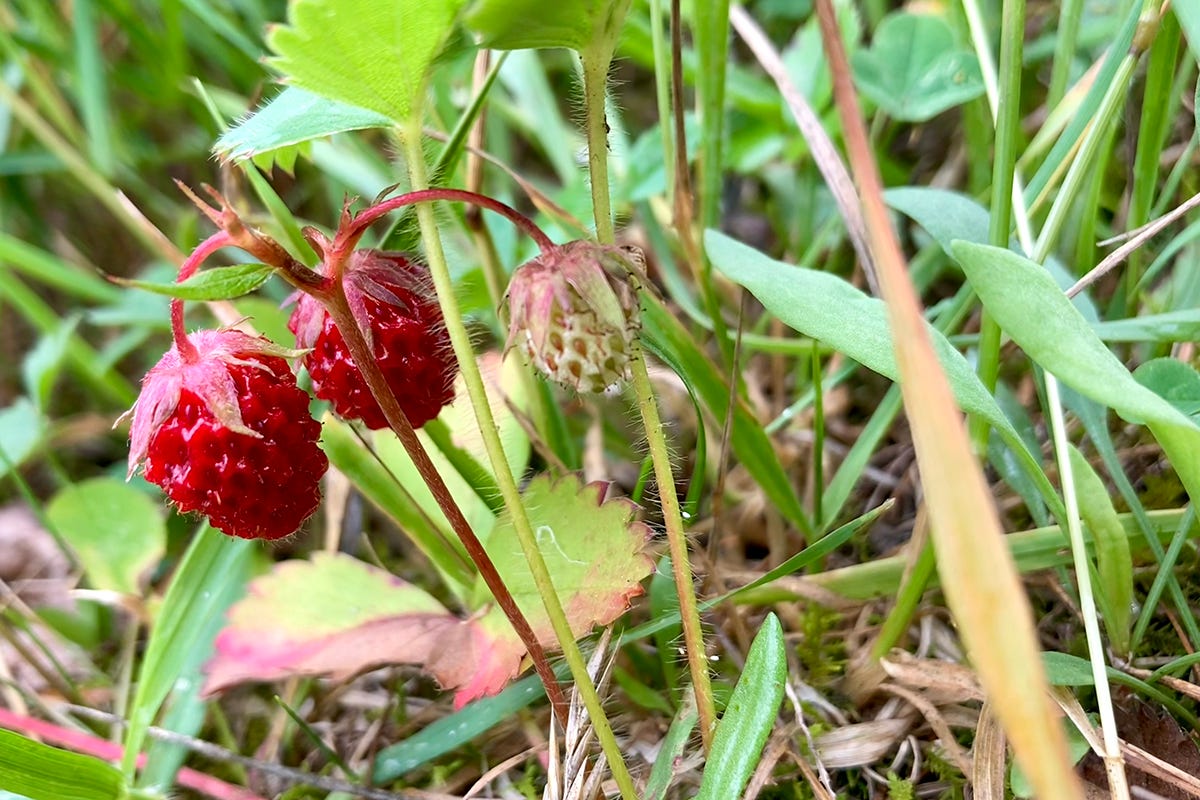
photo by sol 3
[In this newsletter] there is always some treasure to be discovered or forgotten wisdom to be remembered. ...There is a resonant tone and truth in your writing that leaves me feeling a certain kinship in this sometimes estranged world. A community outside of the intimate and intentional relationships that I have seeded and cultivated over this lifetime. A place for some of us to keep the faith in humanity and the hope to stay connected. ...Thank you for being a connection to a greater truth that can often be muddled by the thick fog of reality.
- Katrina
tidbits...
resources on anti-racism, environmentalism and food culture AKA stuff we’re reading / listening to / watching / noticing / thinking about / captivated by this Tuesday . . .
Do One Small Thing . . . what does the ken’ niiohontésha (strawberry) mean to you? Are there memories, traditions, recipes, rituals, or routines that connect you with the strawberry? Reply to this newsletter, share in the comments, or email us at info@goodfoodjobs.com to let us know.
Come to the silent auction at the Kana'tsiohare:ke strawberry festival on Saturday June 27, 2026 and bid on a jar of wild strawberry preserves! Made with strawberries gathered at the historic site of Caughnawaga village this June.
Read the Kanien'kehá:ka Creation Story, adapted from Mohawk storyteller Ionataié:was (Kay Olan). © Mohawk Language Custodian Association – Kontinonhstáts ne Kanien'kéha.
Read the words of Sakokweniónkwas, Ionataié:was, Paul Kayeneseh Williams, Doug George-Kanentiio and John Mohawk in Kanatsiohareke: Traditional Mohawk Indians Return to Their Ancestral Homelands.
Learn more about the Haudenosaunee (People of the Longhouse) Confederacy, thanksgiving address and creation stories, the origins of U.S. democracy and so much more in this collection of stories told by Sakokweniónkwas: And Grandma Said…Iroquois Teachings as passed down through the oral tradition.
From the Northern Cherokee Nation, “The Cherokee Legend of the First Strawberry.”
“My great fear is that we are all suffering from amnesia” - Eduardo Galeano, for The Guardian.
Check out the young adult adaptation of Robin Wall Kimmerer’s bestselling Braiding Sweetgrass, adapted by Monique Gray Smith and illustrated by Nicole Neidhardt.
Marisa Renee Lee on Healing, Strawberries, and Summer Fun.
Sara Sadek on Shattering the Cages: Who We’re Allowed to Become.
“Grief has always been communal, and something in us still knows it.” - The Center for Body Trust is offering more ways to tend grief together: Tending: Accompaniment at The Gates of Grief (June 26–August 28), and Grief & The Body (September 4–October 30).
Read or listen to Adam Wilson on Gratitude Pooling.
Get your copy of Dorothy’s new book - online, from your favorite local bookstore, by asking your local library to carry it, or requesting it on the Libby app.
View and share this free guide to How to Write a More Equitable Job Post, and stay tuned for new resources to deepen this work.
got a tidbit? drop it here for us and we’ll share it in next week’s newsletter.