THERE'S A NATURAL DESIRE . . .
to find The One formula that will make everything easier and better in an instant. When it comes to food, we nurture a hope that someone will hand over a recipe, swearing it's the best - the one we've been searching for! - and we'll be able to follow it to the letter and get the desired result.
In particular, I am thinking about my mother-in-law Bonnie's Tarte Tatin. I've been making it with her widowed husband according to the way that she taught him (he took over the tarte tatin making about a decade ago), but in his new oven the tarte tatin just won't set in the same way.
So I set out to find her written recipe in her files. The measurements, times, and temperatures are different than what he swears she taught him.
But here is the thing that I know to be true: Bonnie didn't make the best tarte tatin because she followed a recipe. If anything, it was a technique, it was a practice - one that she cultivated by making 14 of them each day for two years straight while working at a restaurant that had them on the menu.
You can't fake that type of intimacy. You can't force that level of connection. Her ability to whip up a tarte tatin wherever she went - no matter the ingredients, the tools, etc., has to do with the way that she knew how the variables interacted with each other, how she could observe and listen and coax it to get the desired results. She could adjust on the fly. She could rely on her intuition. She could trust her abilities. These earned elements were muscles she exercised over time. A web of support that helped her along.
Of course, the idea of a 'recipe' is not just applicable to food, but to our lives. We are all hoping for a quick fix - in particular, a vote - that will ease our suffering and make our lives better. And here is the hard truth: there is no one thing that is going to be the silver bullet to achieve the desired results. The reality is, it will take committed daily practice - our time, energy, attention, and care (of which casting a vote is one part).
I have a farmer friend who said she used to fall in a pit of despair every time a piece of equipment broke down. She thought, 'WHY ME? Why is this happening?' Until one day she realized that it was just a cost of doing business...and once she no longer spent a majority of her time and energy feeling like the fates were conspiring against her, it was much easier to work toward solutions.
That is not to make light of the challenges ahead. The 'costs of doing business' in our current capitalist culture come with huge price tags - they come at the cost of people's lives. More than ever, we will all need to engage in community-based daily practices to build webs of support to help each other through in ways that our government (here in the United States, at least) is unwilling to do. While the reflex to numb, entertain, or self-care our way to our best life remains present, it is only when we build these strong webs of support for all - together - that we will get what we truly crave.
The time will pass regardless. The crises will mount regardless. We might as well roll up our sleeves and practice to build the intimacy, imagination, and connection that will get us the results we desire.
We're in it with you,
Dor + Tay
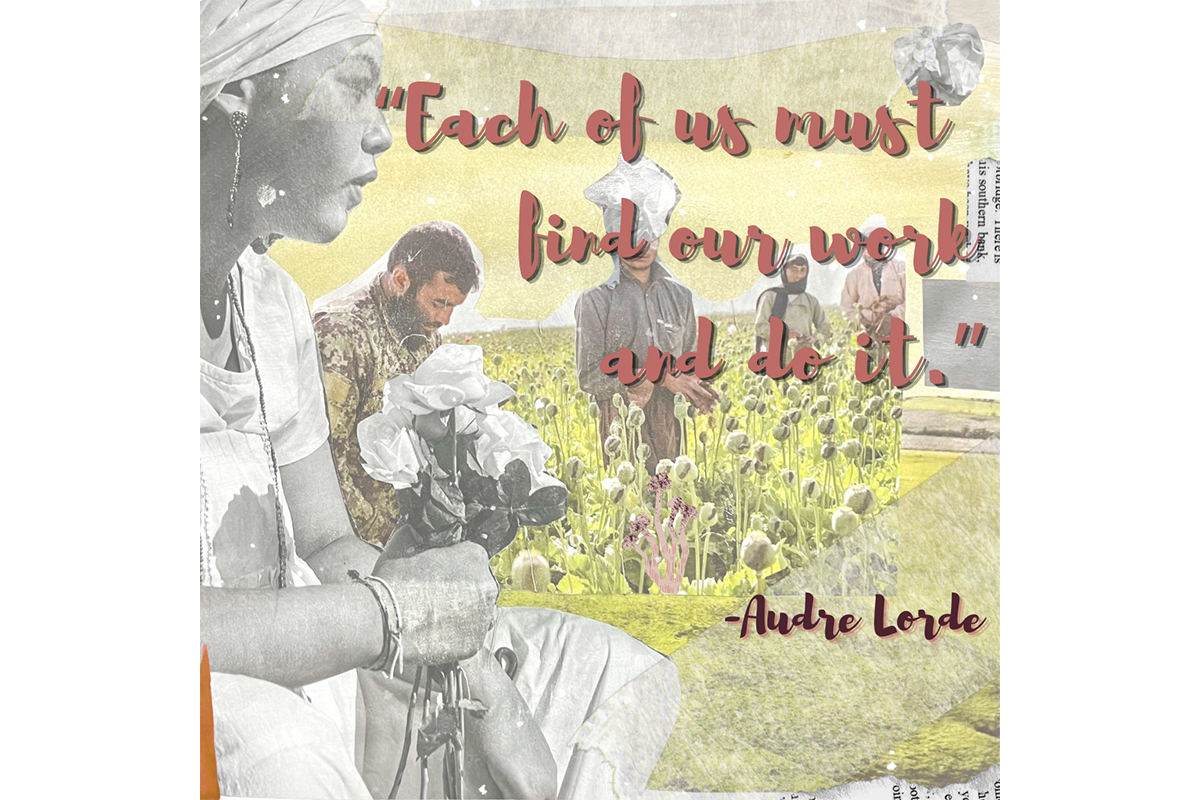
original artwork by Candace Caston, collage and acrylic gouache on paper with digital text
|