|
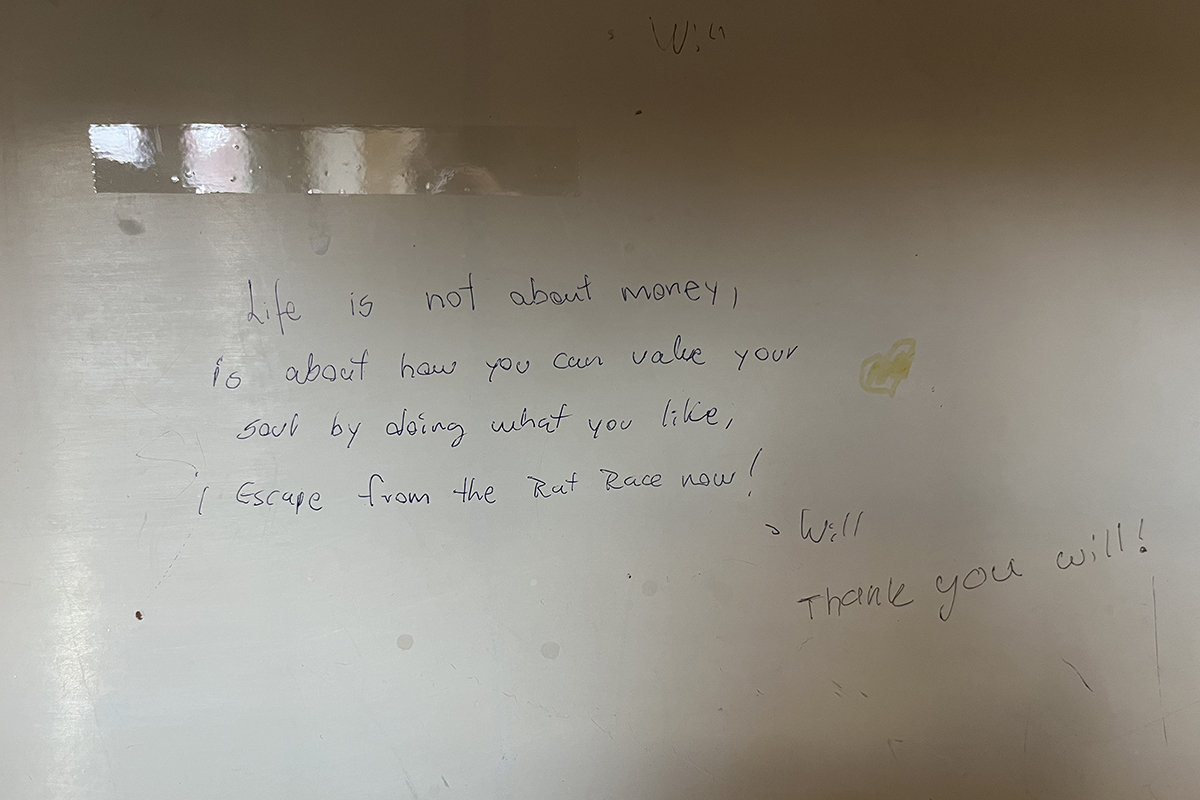
A SCRAWLED MESSAGE APPEARS . . .
If you're having trouble reading it, it says: "Life is not about money, is about how you can value your soul by doing what you like, escape from the rat race now!" (Signed 'Will', with a follow-up message of 'Thank you Will!' added below.)
I encountered this message in a library kiosk, what feels like many seasons ago, and took the photo, thinking about all of you. I want to point out that while life may not be 'about' money, money is nonetheless an essential part of the current structure of livelihood-making - a tool for autonomy, freedom, and dignity - and therefore dismissing it entirely is a form of toxic positivity.
Nevertheless, this message resonates. For me, it's the part about how 'doing what you like' is a way to 'value your soul.'
'Doing what you like' may seem like a throwaway statement - the kind of thing you respond to by saying, "Be serious." I like to think of it as purposefully broad. 'What you like' may include countless examples of the smallest, simplest acts, each one a legitimate interpretation of listening to your inner self and responding to it. The result of such a practice is no less than a messaging system with your soul: a continuous flow of listening, acting, and affirming your soul's value, which responds by giving you more messages to listen for.
It occurred to me last week that any person can walk into any room, at any time, and encounter someone who is capable of making you feel like you matter less. We tend to assign more meaning to such experiences than they call for - we think that if we receive a message from a critic, it must be because the message is true with a capital T. There is no way to avoid such messages, or eradicate them from life. But what would happen if we had a preemptive response to such messages? One that shortened the amount of time we were willing to spend with the voice of the critic.
About a year and a half ago, I learned from a mental health professional that the average length of an emotion is 3 seconds. It seemed preposterous. But it immediately made me think that if an emotion only lasts that long, in the firing of our synapses and the messaging system of our brains and bodies...then it's we humans who are responsible for making them last longer. That means it's not the emotion itself that stays with us, it's the story we begin to tell when prompted by that emotion.
If we don't attach to an emotion with a story, what happens to it instead? I wonder the same thing about a critic: if we spend only as much time with their message as it takes to convey it, then what happens when we leave it behind? Well, we may have to sit with the reality of our flaws or imperfections. But what are our flaws and imperfections, without the critic? I think they are part of what Jennifer Breheny Wallace refers to as 'the beautiful mess.'
In her book, Mattering: the Secret to a Life of Deep Connection and Purpose, Wallace writes: "Often, we think that saying “yes” means we have to have our act together. Researchers call this the Beautiful Mess Effect—our tendency to overestimate how harshly others will judge us when we reveal a weakness or failure while underestimating how much they will appreciate our openness. Studies show that while we may see our vulnerability as a flaw, others tend to see it as a strength and a display of warmth, evidence that we are trustworthy. The very thing we fear might push people away is often what draws them closer. Think of it this way: Have you ever tried to tape something to a slick, shiny surface? It doesn’t stick for very long. It’s the rough part, the messy part, that allows for the stickiness to take hold. In the same way, it’s those imperfect parts of ourselves that create paths to true connection by giving others something real to hold onto."
I think that fear is mostly responsible for the stories we attach to our emotions, and the critics' voices that trigger them. The thing about the critics who make us feel less than is...a lot of those critical assessments are coming from fear within the critic themself. Before we internalize that fear or adopt it as our own, it's worthwhile to consider that it's a fear that doesn't belong to us, trying to escape the outside for our insides.
Fear causes us to be skeptical and to distrust. It blocks our ability to listen to what our soul values. An atmosphere of despair or cruelty can cause us to question things, in a convincing but fruitless attempt to head off disappointment, to prove that kindness is temporary, or less powerful than cruelty. When we affirm the value of our souls, when we listen to the messages they send to us, and respond, we counteract fear, we spend less time with the voices of critics and the stories we tell about them, and we allow ourselves to become more vulnerable, so we can do more of what we like.
Some thoughts from readers last week:
from Michael: "Worry spurs reactionary people - to act, rise up to the occasion, while the majority wait to be told what to do. That is now playing out across the US and the globe. Recently, there have been tremendous wins overseas elevating more equitable societal gains and respectable leadership that has not been covered by US media. Fear not, positive change is on the horizon...There are two sayings I use when folk don't see any light at the end of the tunnel: 'Worrying is like praying for something bad to happen. Taking action helps diminish negative thoughts' (Anonymous), and 'You can't go back and change the beginning, but you can start where you are and change the ending' (C.S. Lewis)."
from Robyn: "There was a new addition [to the bylaws of a community board] that was very exclusionary and limiting, and completely unnecessary. I fought against it vehemently, mostly on my own, but finally, at our meeting last night, others spoke up and agreed that it should be removed. My one voice was loud but I'm not sure it would've been enough. The other members of the board were newly elected and probably didn't feel like they were allowed to have a voice. I am so proud of them for speaking up for what they believed in, and in the end, we succeeded in getting that new bylaw removed."
Together,
Dor + Tay
|