 |
| ISSUE NO. 618 |
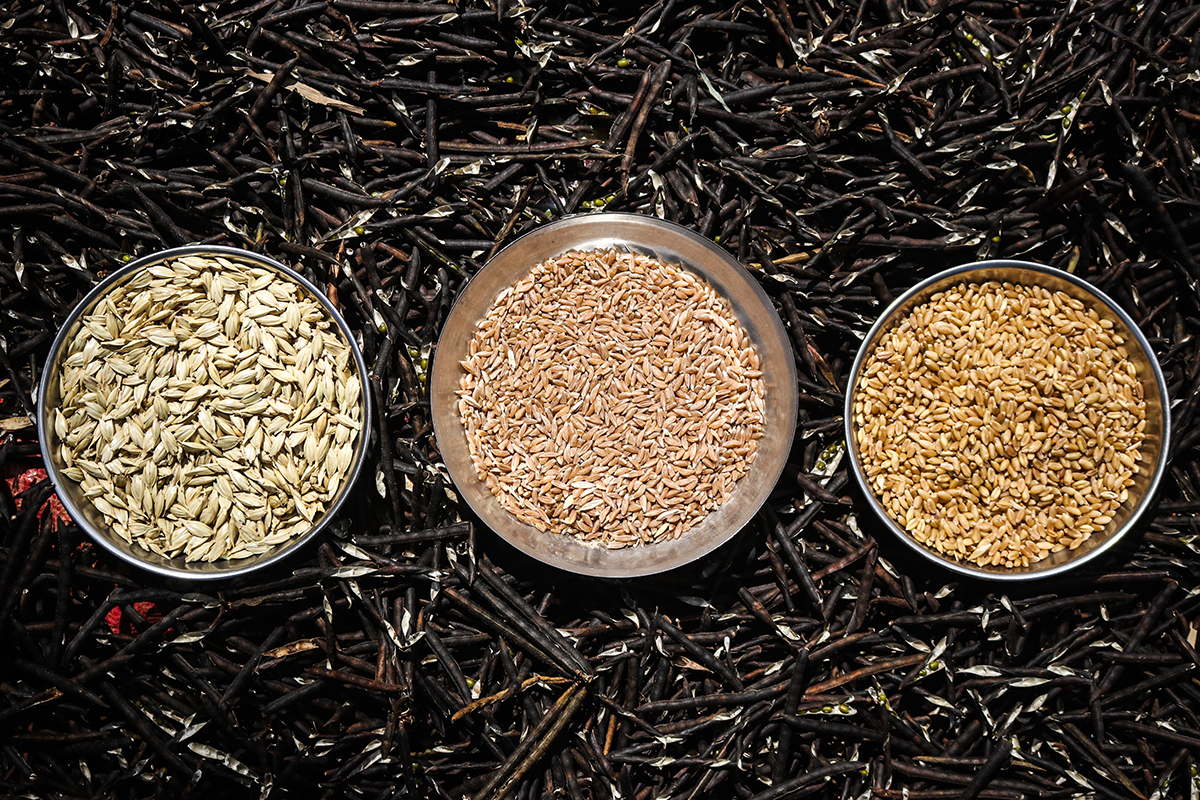
| This week's newsletter was written by Sanket Jain, an independent journalist and documentary photographer based in Kolhapur, India. Jain is a Senior People's Archive of Rural India fellow, where he's documenting vanishing livelihoods and dying art forms from India's remote villages. He is also the co-founder of Insight Walk, a nonprofit that offers teaching fellowships to rural community women. These women work to ensure every child in their village has access to contextual education of their choice - at Insight Walk, ever student designs their own syllabus. Follow Jain's work on instagram @snkt_jain. OVER A CENTURY BACK . . . farmer Bala Gaikwad asked his son never to break this promise: “You can skip going to the temple, but never stop cultivating the emmer wheat,” he said. Today, even his grandson, Sakharam Gaikwad, now in his mid-80s, has kept the promise. He has carried a legacy of cultivating emmer wheat for over 150 years. Emmer wheat (Triticum dicoccum) is considered to be first cultivated roughly 10,000 years ago in the Fertile Crescent (found in the middle-east), the cradle of civilization. With an estimated production of 106.84 million tons this year, India remains the second-highest wheat-producing country worldwide. However, emmer wheat’s cultivation is on a rapid decline. “It takes around five months to grow. Whereas the hybrid varieties promise a much higher return in less than three months,” shares Gaikwad about its rapid decline. Popularly known as Khapli gehu in India, it’s primarily cultivated in the states of Maharashtra, Karnataka, and Gujarat. Emmer is hulled wheat, which means it has strong husks that, after threshing, separate into smaller components called spikelets, an impenetrable fortress for the grain. These strong hulls protect it from several pests, thereby increasing its shelf life. However, it also requires tremendous back-breaking labor, especially prior to the advent of threshing machines.
Sakharam says emmer wheat is one of the few crops that survived the heat waves and rapidly changing local climatic patterns. Khapli is naturally resistant to several pests and fungal infections, eliminating the need for chemical fertilizers and pesticides. “Today, we can’t cultivate hybrid variety without using chemicals.” Moreover, even if the farmer misses planting it by over 45 days, the crop still gives a better yield, unlike the hybrid counterpart, which has to be sown in time. Khapli, which has a higher amount of protein than the modern varieties, has immense health benefits. It is rich in fiber, which helps moderate weight and makes for a complete diet with lesser calories. It also forms a part of a heart-healthy diet as the higher fiber content helps maintain cardiovascular health. In addition, since emmer has a low glycemic index compared to the modern varieties, it helps keep blood sugar levels in check.
Today, it fetches a handsome price of almost Rs 100 ($1.2) per kilogram, thrice that of the hybrid varieties. “However, cultivating this is labor intensive, and the production is less,” shares Sakharam’s wife, Housabai, who’s in her late 70s. She believes over 60 farmers once cultivated this crop in her Jambhali village of Maharashtra’s Kolhapur district; today, it is down to just a handful.
Since his youth, he has been making an interesting observation to track how traditional crops are on the decline. “Looking at the changing breakfast items, you can say how several indigenous crops are going extinct. Earlier, we ate an entire bowl of porridge made from khapli followed by two bhakri (indigenous sorghum flatbread), thecha (spicy condiment made using chilies, garlic, coconut), and curd.” Relying on emmer wheat alone couldn’t sustain his livelihood, due to the lower production yield, but, he says proudly, “Despite cultivating sugarcane and other cash crops, I kept my father’s word.” . . .
Yours in food, justice, and food justice, |
tidbits...resources on anti-racism, environmentalism and food culture AKA stuff we're reading / listening to / watching / noticing / thinking about / captivated by this Tuesday . . . |
 |